
Kansas Court Records After an Arrest
After an arrest in Kansas, the first public record may be a county jail entry maintained by the sheriff or detention center. That booking record can be useful for current custody, location, booking date, arresting agency, bond notes, and sometimes a booking photo. It is not the final court record. The court side begins when the county or district prosecutor files charges in the proper Kansas district court, and that court case can move differently from the jail roster entry that started the search.
Use the jail pages for custody questions and the court portals for filed-case questions. The Kansas inmate records page explains how county jail rosters, KASPER, BOP, ICE, and Kansas VINE fit together. The jail rosters and mugshots page explains booking-photo access. This page focuses on Kansas court records after a jail arrest: where filed charges appear, how those charges can change, and how court status differs from custody status.
Kansas Case Search at casesearch.kscourts.gov is the statewide public entry point for district-court case information available under Kansas law.
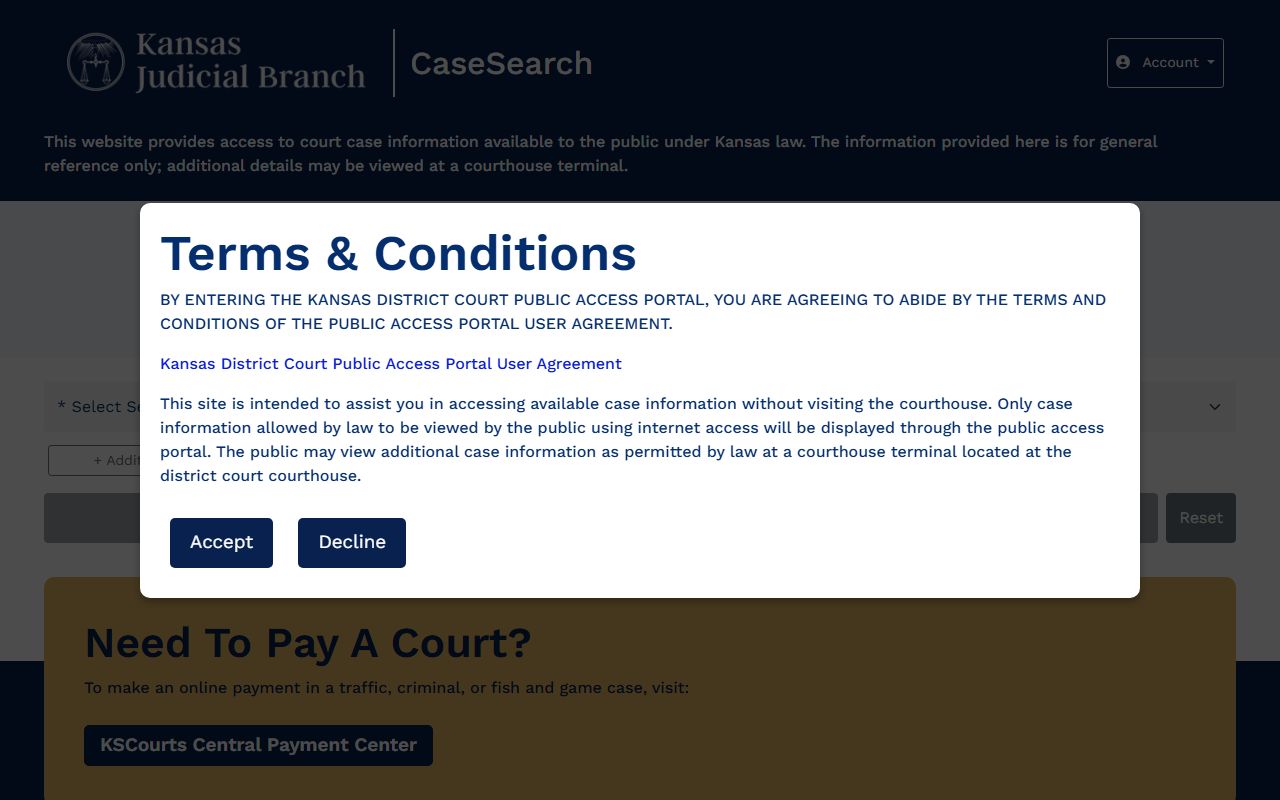
The portal is useful when a user has a defendant name, case number, business name, citation, or other case-search detail, but it should not be treated as proof that someone is currently in jail.
How Kansas Trial Courts Are Organized
Criminal cases after a Kansas arrest are generally handled in the district court for the county where the case is filed. County geography still matters because the arrest county, holding county, prosecutor, district court, and jail roster may be connected but not identical. In rural Kansas, regional custody paths can also send a detainee to a neighboring county jail while the case remains tied to the arresting county's court. That is why a statewide search should identify both the court county and the facility where the person is held.
The Kansas Judicial Branch explains public district-court record access through its district-court records page at kscourts.gov/eCourt/District-Court-Records.
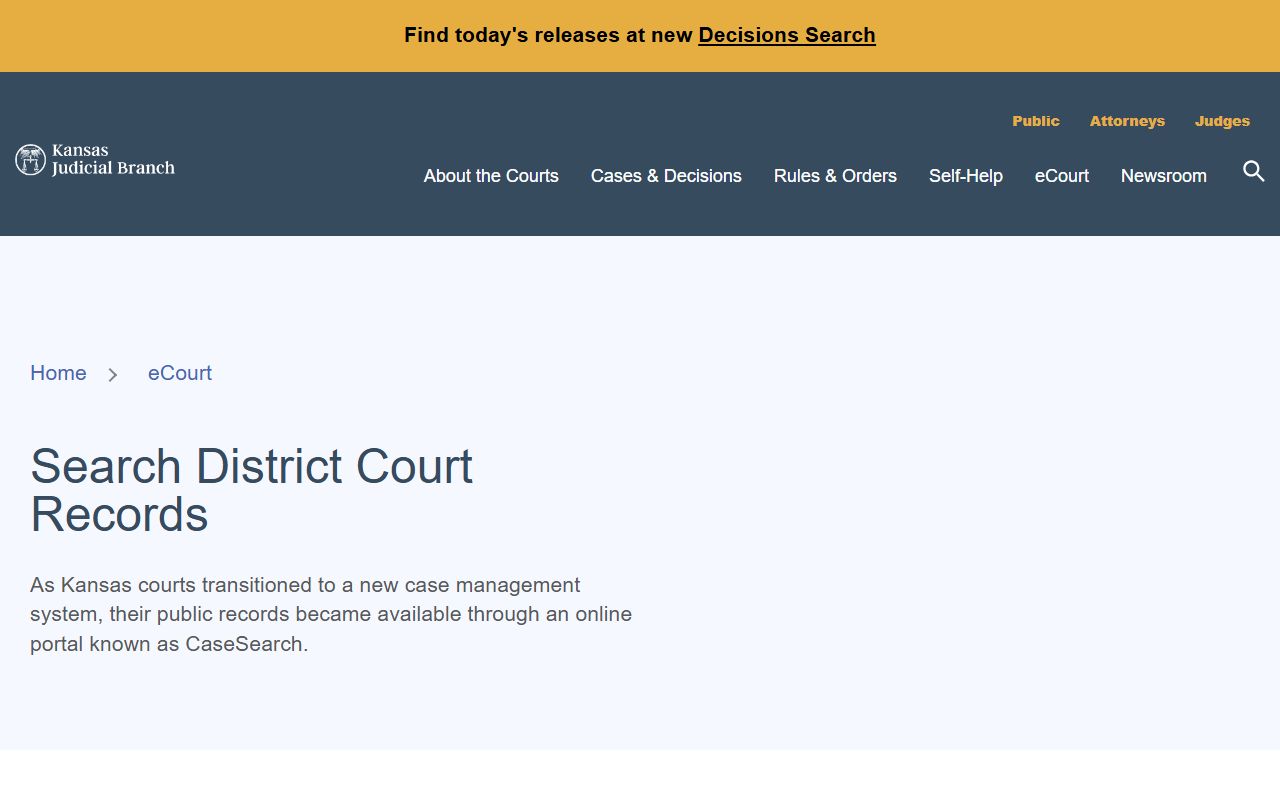
That statewide court-records path complements county jail rosters. It does not replace the sheriff's roster for current custody, and it does not replace KDOC KASPER for sentenced Kansas prison custody.
How to Find Kansas Court Records After an Arrest
Start by deciding what question needs answering. If the question is whether a person is currently held, start with the county jail, Kansas VINE, or the appropriate custody locator. If the question is whether charges have been filed, whether a first appearance occurred, whether a hearing is scheduled, or how a case was resolved, use Kansas court records. An arrest can appear on a roster before a court case is filed, and a court case can remain public after the person is released from jail.
- Open Kansas Case Search or the Kansas Judicial Branch district-court records page.
- Search by defendant name, case number, citation, or other available party information.
- Confirm the county, case type, filing date, and defendant identity before relying on a result.
- Read each charge, event, hearing, disposition, and bond entry in context.
- Use the Kansas county directory if the custody question still depends on a local jail roster.
Names can be common, booking names can include aliases or middle-name differences, and older records may require courthouse-terminal access. A user who cannot find a new case immediately after an arrest should check the jail roster and then return to the court portal after filing, first appearance, or arraignment activity has had time to post.
How Charges Get Filed After a Kansas Arrest
Booking charges are the law-enforcement side of the event. Filed charges are the prosecutor and court side. The prosecutor can file charges that match the jail roster, choose different charges, decline some allegations, add counts after review, or amend charges later. Court records after a jail arrest should therefore be read as the official case track, while the jail roster is the custody track.
| Record | What It Usually Means | Where to Check |
|---|---|---|
| Booking entry | Jail intake record tied to an arrest, hold, warrant, or transfer. | County jail roster or facility page. |
| Complaint or information | Charging document filed by the prosecutor to start or continue the criminal case. | Kansas district court record. |
| Indictment | Grand-jury charging path used in limited matters. | Kansas district court record. |
| Disposition | Resolution such as plea, dismissal, acquittal, diversion, sentencing, or other order. | Kansas district court record. |
Charge Status in Kansas Court Records After Arrest
Charge status can change at several points. A prosecutor may amend a charge after reviewing reports, video, lab results, witness statements, criminal history, or plea negotiations. A judge may dismiss a count, bind over a different count, accept a plea to a lesser offense, or sentence on only some counts. A jail roster may continue to show the arrest or booking labels while the court record shows a more precise case path.
| Status | Plain-English Reading |
|---|---|
| Pending | The charge remains active and has not reached final disposition. |
| Amended or reduced | The filed charge changed from the original wording, severity, or count. |
| Dismissed | The court record shows the count or case was dismissed, though other counts may remain. |
| Diversion | The case may be handled through a diversion agreement rather than an ordinary conviction path. |
| Convicted | The record reflects a plea or finding of guilt on that count. |
Bond, Holds, and Release After an Arrest
Bond information can appear in both jail and court records, but it serves different purposes. A jail roster may show the amount needed for release from that facility. A court record may show the bond order, conditions, next appearance, or later modifications. Bond schedules and local procedures vary by county, so the statewide rule is to verify the active order with the court or the holding jail before sending money, hiring a surety, or assuming a person is eligible for release.
| Release Issue | How to Read It |
|---|---|
| Cash bond | Money is posted directly under the court or jail's rules. |
| Surety bond | A licensed bond company posts the bond subject to local requirements. |
| Own recognizance or PR | The court allows release without posting the full money amount, usually with conditions. |
| No-bond hold | Release may be blocked by a warrant, detainer, probation matter, parole issue, immigration matter, or court order. |
Court Records Do Not Prove Current Custody
Kansas custody searches require the right system. KDOC's KASPER page at kdocrepository.doc.ks.gov/kasper/search/disclaimer explains that the Kansas Adult Supervised Population Electronic Repository is tied to persons and cases associated with KDOC-funded or KDOC-operated programs.
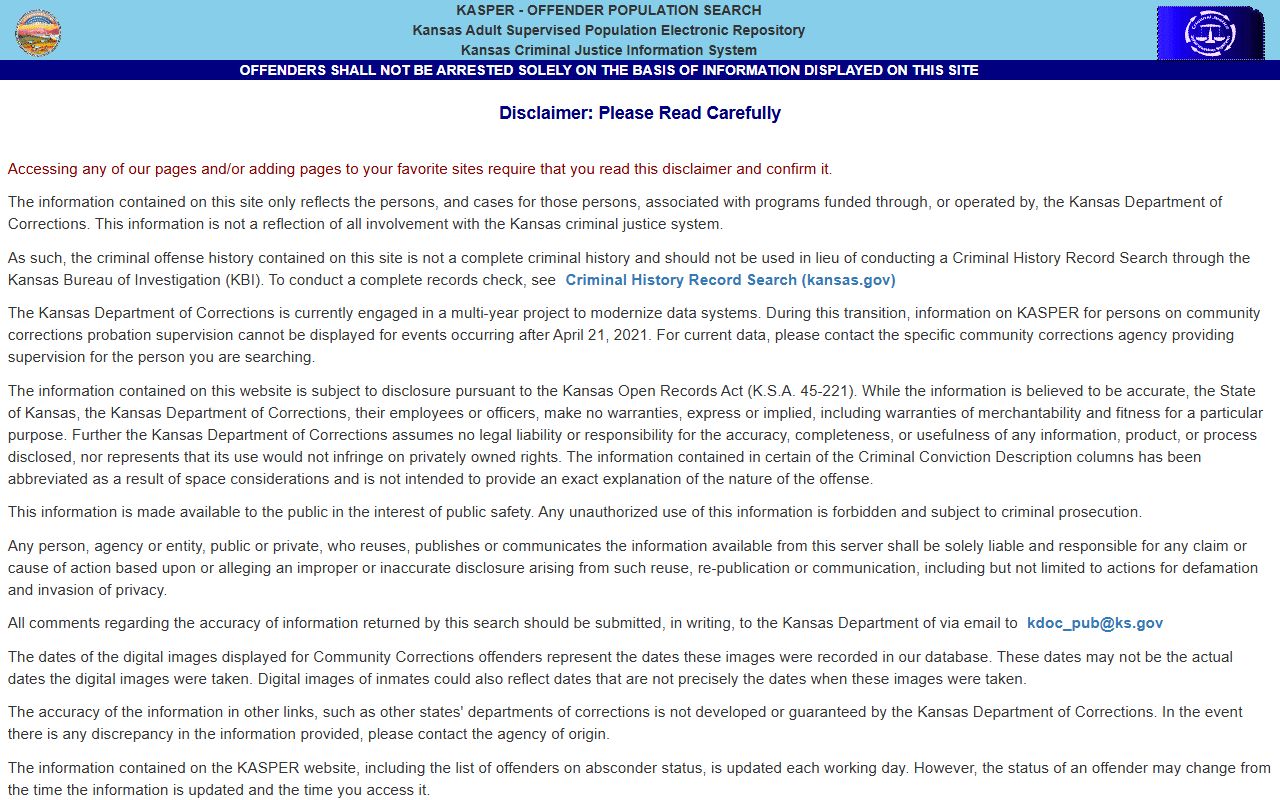
KASPER is the correct path for sentenced Kansas prison custody and KDOC supervision status, not for every fresh county booking. Federal custody uses BOP, immigration detention uses ICE ODLS, and county jail custody uses the county roster or Kansas VINE when the jail participates.
Kansas VINE at vinelink.vineapps.com/state/KS/ENGLISH is a statewide county-jail custody search and notification path.
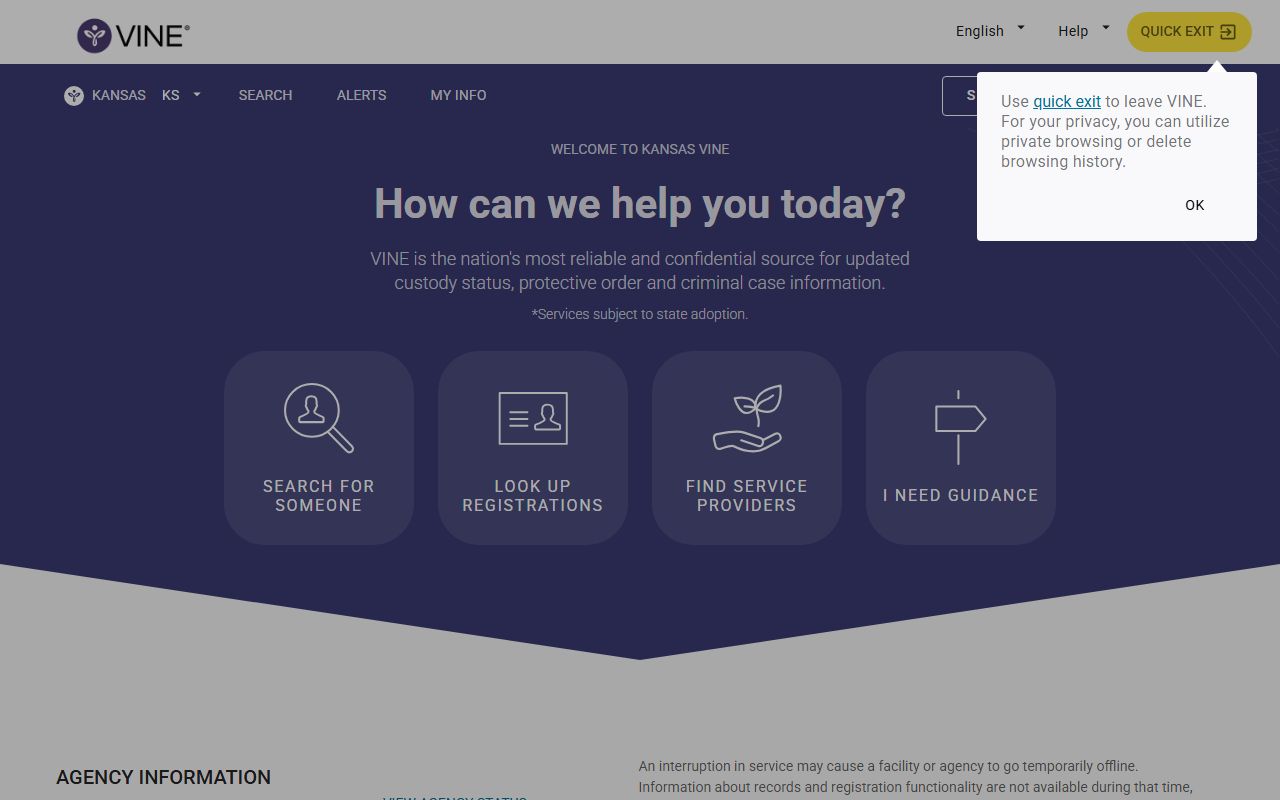
The Kansas Attorney General's VINE material states that Kansas VINE is specific to offenders housed in county jails and does not include KDOC offenders housed in state prisons. That distinction is central when a court case exists but the current holding agency is unclear.
Charges vs. Convictions
An arrest and a charge are not the same as a conviction. A person can be arrested and released without a later conviction. A prosecutor can file charges that are later dismissed or reduced. A court can enter diversion, judgment, sentence, probation, postrelease supervision, or other orders depending on the case. Public court records should be read as a case history, not as a shortcut for guilt or current risk.
| Charge | Conviction | |
|---|---|---|
| Stage | Accusation filed in court. | Result after plea, verdict, or qualifying finding. |
| Custody impact | May affect bond, holds, or release conditions. | May lead to jail, probation, KDOC custody, fines, or postrelease terms. |
| Record caution | Can be amended, dismissed, or resolved without conviction. | Still may be affected by appeal, expungement, or later orders. |
Expunged Arrest and Court Records in Kansas
Kansas expungement is governed by state law and depends on the type of case, outcome, waiting period, criminal history, and statutory exceptions. Research for this build identifies K.S.A. 21-6614 as the key Kansas statute for expungement of convictions, arrest records, and diversion agreements. Expungement is not automatic just because a person was released from jail, and a court record may remain public unless a court grants relief under the applicable law.
Juvenile matters, sealed records, expunged records, criminal investigation records, victim information, some warrants, and records restricted by court order or statute may be unavailable through ordinary public search. When a public search does not show a record, the reason can be timing, county migration, search criteria, courthouse-only access, or legal restriction. It should not be treated as proof that no arrest or case ever existed.
Background Check Considerations
Casual court lookup is different from an FCRA-regulated background check. Public court records can help a user understand a case, but they may be incomplete, delayed, misread, or confused with another person who has a similar name. Employers, landlords, lenders, insurers, and screening companies must follow laws that apply to consumer reports, adverse action, accuracy, and permissible use.
Important: This website is not a consumer reporting agency and may not be used for credit, employment, tenant, insurance, or other FCRA-regulated decisions.
Kansas Public Records Requests After an Arrest
Kansas public-records access is governed by the Kansas Open Records Act, commonly KORA, codified at K.S.A. 45-215 et seq. K.S.A. 45-216 states the public policy that public records shall be open for inspection unless otherwise provided by law, and K.S.A. 45-218 requires agencies to act on requests as soon as possible, but not later than the end of the third business day after receiving the request. A court-record request usually goes through the court or clerk. A jail-record request usually goes to the sheriff or detention agency that holds the record. A KDOC record request goes through KDOC's KORA process.
Requests should identify the person, case number or booking number if known, date range, county, record type, and whether inspection or copies are requested. Agencies may charge allowed costs, require clarification, withhold exempt records, or explain that another custodian holds the record. The practical statewide approach is to search first, then request only the specific missing record from the custodian that created or maintains it.
Public Record Search
Sponsored Results