
What Is KDOC?
KDOC means the Kansas Department of Corrections. The agency's own materials use the abbreviation KDOC across its website, contacts, KASPER context, KORA materials, and facility information. KDOC's central office is identified in the Kansas research at 714 SW Jackson, Suite 300, Topeka, Kansas 66603, with public email at KDOC_Pub@ks.gov and central-office phone at (785) 296-3317. For search purposes, KDOC is the statewide authority for sentenced Kansas prison custody, parole services, postrelease supervision, adult correctional facilities, reentry, victim services, resident banking, communications, visitation, KORA requests, and population reports.
The most important distinction is local versus state custody. County jails hold new arrests, pretrial detainees, local-sentence inmates, municipal prisoners, warrant holds, and people awaiting transfer. KDOC holds or supervises people connected to Kansas Department of Corrections programs and sentences after a court commitment to the Secretary of Corrections. A person arrested in Wichita, Topeka, Olathe, Kansas City, Dodge City, Salina, Garden City, or a smaller county seat usually appears first in a county jail system if the local sheriff publishes one. After sentencing to KDOC custody, that person may move into the KDOC inmate population and become searchable through KASPER.
The KDOC contacts page confirms the Kansas Department of Corrections central contact path and agency identity.
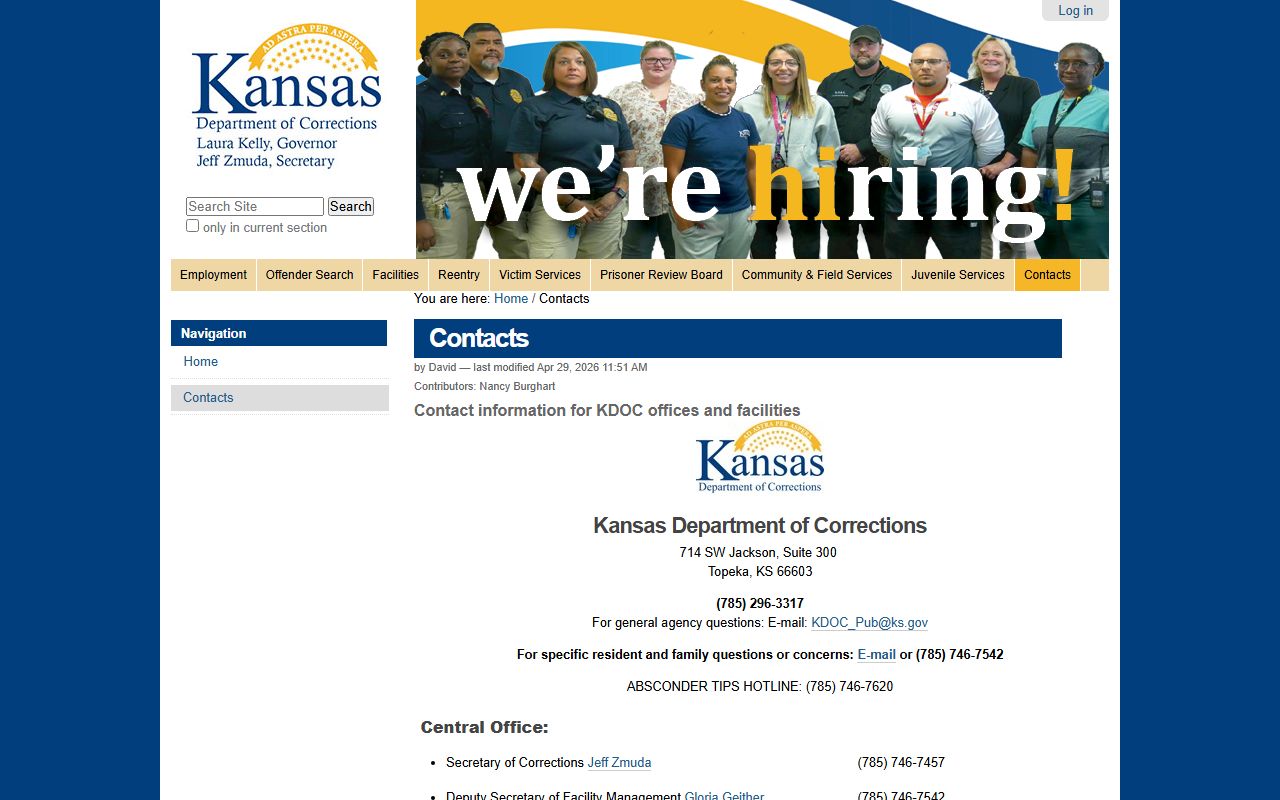
Central contact details help separate KDOC records questions from county jail booking questions that belong to local sheriffs.
The KDOC Inmate Population
The KDOC inmate population should be described with dated figures. KDOC's Daily Population Report generated May 7, 2026 for May 6, 2026 showed 9,800 total inmates in KDOC and non-KDOC facilities, including 8,918 male inmates and 882 female inmates. It separated 9,788 inmates in KDOC facilities from 12 in non-KDOC facilities. The same report's summary showed an end-of-April 2026 total of 9,802, up 125 over the prior 12 months and up 75 from July 1, 2025 through April 30, 2026.
KDOC's Current Population Totals page gives another public cross-check. The table was marked updated September 18, 2025 and listed adult correctional-facility population and capacity at 9,849 / 10,674. It also listed 8,974 / 9,738 male adult facility population and capacity, 875 / 936 female adult facility population and capacity, and 5,357 adult parolees. Those dashboard figures are not county jail numbers. They describe adult KDOC facilities and parole, while local jail rosters remain under county control.
| Measure | Figure | Source |
|---|---|---|
| KDOC and non-KDOC inmate total | 9,800 | Daily Population Report, May 6, 2026 |
| Male / female inmates | 8,918 / 882 | Daily Population Report, May 6, 2026 |
| KDOC facilities / non-KDOC facilities | 9,788 / 12 | Daily Population Report, May 6, 2026 |
| Adult facility population / capacity | 9,849 / 10,674 | Current Population Totals table, September 18, 2025 |
KDOC Inmate Locator Search
The official KDOC inmate locator is KASPER, the Kansas Adult Supervised Population Electronic Repository. The public entry point is the KASPER disclaimer. KASPER's own header identifies it as the offender population search under the Kansas Criminal Justice Information System. The disclaimer warns that people must not be arrested solely on information displayed there, and it states that KASPER reflects persons and cases associated with programs funded through or operated by KDOC. It is not a full Kansas criminal-history search and does not replace county jail rosters or KBI criminal-history processes.
- Open the KASPER disclaimer and read the scope limits before agreeing to continue.
- Search by legal name, KDOC registration number, or other identifying details when known.
- Open the matching profile and compare name, KDOC number, physical description, and conviction details.
- Use the housing, movement, supervision, custody-level, and anticipated-release fields carefully because status can change after the last update.
- If a recent arrest does not appear, check the county jail roster, Kansas VINE, or the facility directory instead of assuming no custody exists.
The KASPER inmate locator disclaimer is shown before the KDOC inmate search form.
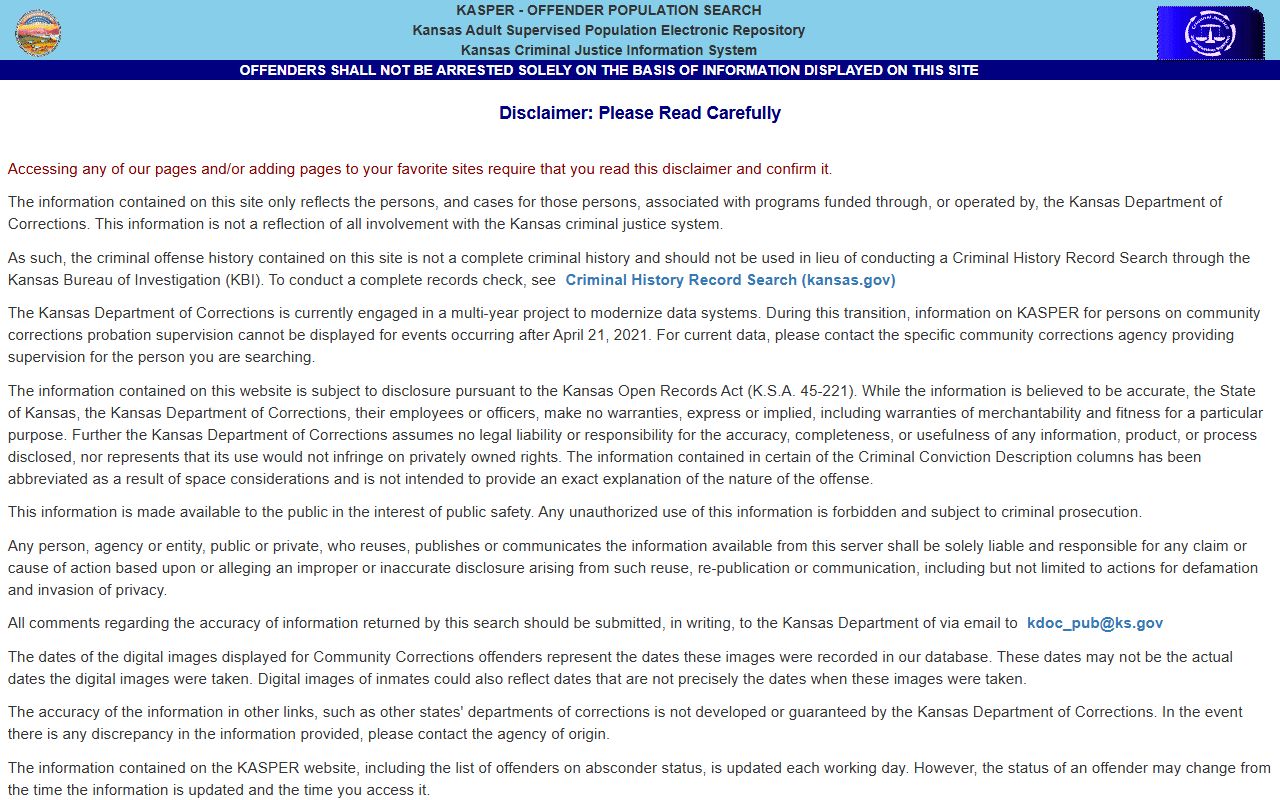
KASPER's warning language is central to the KDOC page because it defines what the state locator does and does not cover.
KDOC Inmate Record Fields
KDOC's locating FAQ says KASPER information is updated daily, excluding weekends. It describes the database as containing information about offenders sentenced to the custody of the Secretary of Corrections since 1980. KASPER includes people currently incarcerated, people under post-incarceration supervision, and people discharged from a sentence. It does not have available information about inmates sent to Kansas under the interstate compact. Those limits should shape every KDOC inmate population search.
| Field | What It Shows |
|---|---|
| Name and KDOC registration number | The state corrections identity used in KDOC records, distinct from county booking numbers and court case numbers. |
| Physical description | Identity details that help separate people with similar names. |
| Conviction description | Conviction information, including county and case number where available. |
| Housing and movement history | Current location and prior KDOC facility movement shown by the locator. |
| Custody or supervision level | The KDOC custody or supervision status tied to the person. |
| Anticipated release date | A date that can change because of good time, program credits, forfeitures, revocations, or sentence computation. |
The KDOC locating FAQ explains KASPER coverage, daily updates, and the types of information that can appear.
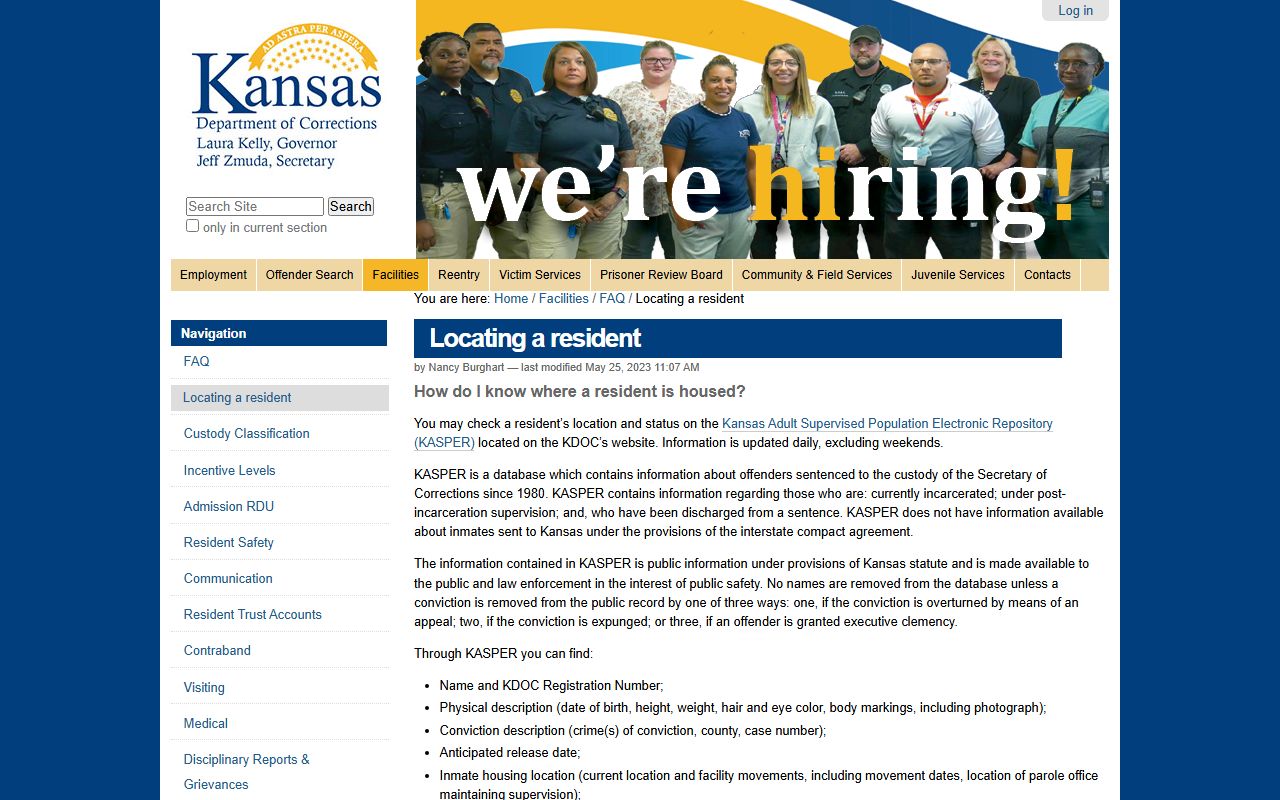
The FAQ is useful when a search result raises a release-date or location question that a county jail roster cannot answer.
KDOC Prisons and Facilities
KDOC's Facilities Map lists correctional-facility cities as El Dorado, Ellsworth, Hutchinson, Lansing, Larned, Norton, Topeka, Wichita, and Winfield. The Adult Facility Index identifies El Dorado Correctional Facility, Ellsworth Correctional Facility, Hutchinson Correctional Facility, Lansing Correctional Facility, Larned State Correctional Facility, Norton Correctional Facility, Topeka Correctional Facility, Winfield Correctional Facility, and Wichita Work Release Facility. KDOC facility material also identifies satellite or unit contexts such as El Dorado's Southeast Medium Unit and Southeast Minimum Unit addresses in Oswego, Ellsworth's East Unit, and Norton's East Unit in Stockton.
Security and custody levels should stay broad at statewide altitude. The research identifies KDOC custody levels such as special management, maximum, high-medium, low-medium, and minimum. A facility's designation reflects the highest custody resident it may hold, and a maximum-security institution may also house lower-custody residents. County research adds context that Hutchinson includes maximum, special management, medium, and minimum custody; Norton includes medium and minimum; Winfield and Wichita Work Release are minimum or work-release settings; and Topeka is the adult female state correctional facility.
The KDOC adult facility index lists the adult facilities that make up the Kansas state prison system.
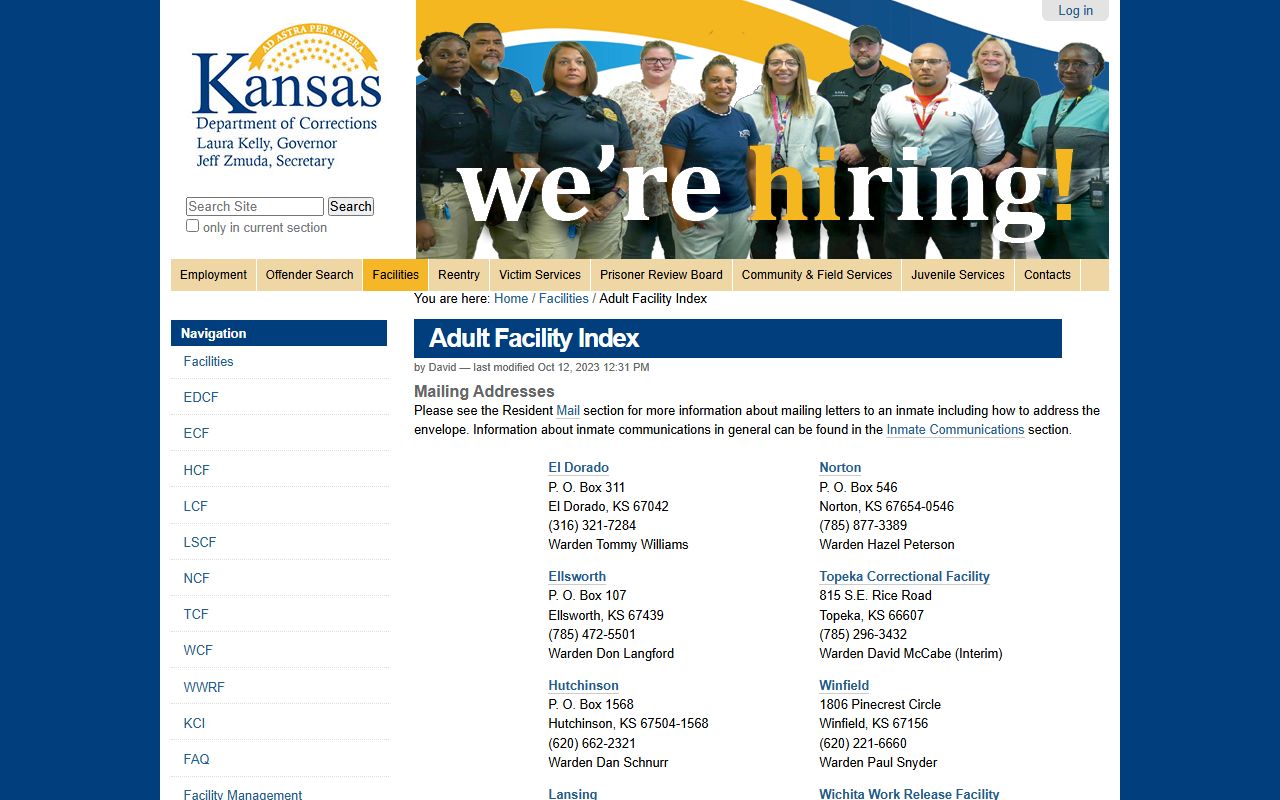
The statewide facility directory includes KDOC institutions beside county jails, but search instructions for KDOC rows should still point to KASPER.
KDOC Sentencing and Release
Kansas has more than one release framework. KDOC's Prisoner Review Board page explains the Board's role under older indeterminate sentences and the post-July 1, 1993 sentencing-guidelines structure. Under the indeterminate structure, the Board decides parole release, sets parole and conditional-release conditions, discharges successful cases based on parole-officer recommendations, and revokes release after violations. Under the post-guidelines structure, the Board establishes postrelease-supervision conditions and handles revocations for violations.
Parole eligibility is not the same as release. KDOC's PRB page says people under the indeterminate structure become parole eligible after serving the minimum sentence less good-time credits calculated by statute. For sentences with a minimum of two years, good time is earned at one day for every day served, which can make parole eligibility occur at half the minimum if all good time is earned. For a one-year minimum, eligibility is reached after nine months. A hearing before the parole eligibility date does not promise release.
For post-guidelines cases, K.S.A. 22-3717 generally shifts the question from parole eligibility to prison term, good-time and program-credit rules, and postrelease supervision. K.S.A. 21-6821 authorizes KDOC rules for good-time calculation and forfeiture. It generally caps good time at 15 percent of the prison portion for crimes committed on or after July 1, 1993, with a 20 percent cap for listed lower-severity nondrug and drug offenses. Program credits can reduce eligible sentences by up to 120 days.
The KDOC Prisoner Review Board page explains parole, postrelease, hearing roles, and decision factors.

Release timing should be described cautiously because sentence computation depends on offense date, sentence type, credits, forfeitures, holds, and board action.
KDOC vs County Jail
The KDOC inmate population is not the same as the county jail population. A county jail roster is the right place for a fresh arrest, pretrial detention, a short local sentence, or a person awaiting transfer. KASPER is the right place for KDOC prison custody, parole, postrelease supervision, and discharge information. Kansas VINE is useful for county-jail custody notifications, and the Attorney General's Kansas VINE page says it is specific to offenders housed in county jails and does not include KDOC offenders housed in state prisons.
| Issue | KDOC State Prison | County Jail |
|---|---|---|
| Who is held | People committed to KDOC custody and related supervision records | New arrests, pretrial detainees, local sentences, and holds |
| Search tool | KASPER | County jail roster, jail phone line, or VINE |
| Agency | Kansas Department of Corrections | County sheriff or local jail authority |
| Identifier | KDOC registration number | Booking number, jail ID, or local roster fields |
Leavenworth County shows why this split matters. The county includes Lansing Correctional Facility, FCI Leavenworth, Leavenworth County's sheriff detention center, military correctional facilities at Fort Leavenworth, and immigration-detention context around Midwest Regional Reception Center. A Kansas inmate search can be state, local, federal, military, or immigration custody depending on the case.
KDOC Records Requests
Kansas public-records access is governed by KORA, the Kansas Open Records Act. KDOC provides an online KORA request process through GovQA and still accepts written or email requests. A strong KDOC records request should identify the record sought, the subject's name and KDOC number if known, a date range, the facility or office if known, and whether inspection or copies are requested. KDOC may charge actual costs where allowed, withhold exempt records, or route the request under KORA and agency policy. KORA requires public agencies to act on requests as soon as possible, but not later than the end of the third business day after receiving the request.
KDOC records requests are for existing records, not a custom research service. Sentence-computation questions, release-date concerns, institutional files, disciplinary records, and population reports may use different KDOC contacts or processes. County jail booking records should go to the county sheriff or jail that maintains them. Court documents should go through Kansas courts. Federal and immigration records use federal agency channels.
KDOC Inmate Population FAQ
What does KDOC stand for?
KDOC stands for Kansas Department of Corrections. It is the statewide corrections agency for Kansas state prisons and KDOC supervision records.
How do I search the KDOC inmate population?
Use KASPER, the Kansas Adult Supervised Population Electronic Repository. Start at the disclaimer, then search by name, KDOC registration number, and other identifying details.
Why is a recent Kansas arrest missing from KASPER?
KASPER is not a universal jail roster. A recent arrest normally appears first in a county jail roster, a jail phone system, Kansas VINE, or later in Kansas Case Search if charges are filed.
Public Record Search
Sponsored Results